On top of the world
Richard Croasdale and James Brown drop in on Stone Brewing’s new Berlin base, for a craft beer experience unlike any other.
Richard Croasdale & James Brown
Monday 02 June 2025

This article is from
Berlin
issue 9
Share this article
Before making the S-Bahn journey south to Stone Brewing’s new European base in the former industrial suburbs of Berlin, I wasn’t quite sure what to expect. With very few exceptions, the craft breweries we’re used to visiting are – to put it nicely – slightly Heath-Robinson affairs, usually sandwiched into whatever space they can find, making the best use of limited resources.
Even on paper though, Stone is quite the opposite, with a reputation for business acumen and ambition, as well as quality. I had asked one Berliner what they had thought of the setup: “It’s very… American,” came the ambiguous reply.
Entering the building for the first time, it is immediately clear that, while this observation was probably true, only the most jaded refusenik would see this as a bad thing. A dream six years in planning, Stone Berlin makes such a strong first impression that any cynicism is blown clean away, leaving me standing in slack-jawed wonder.
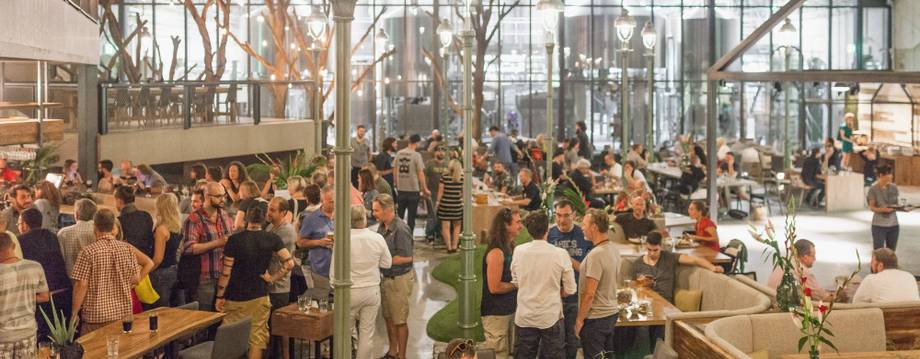
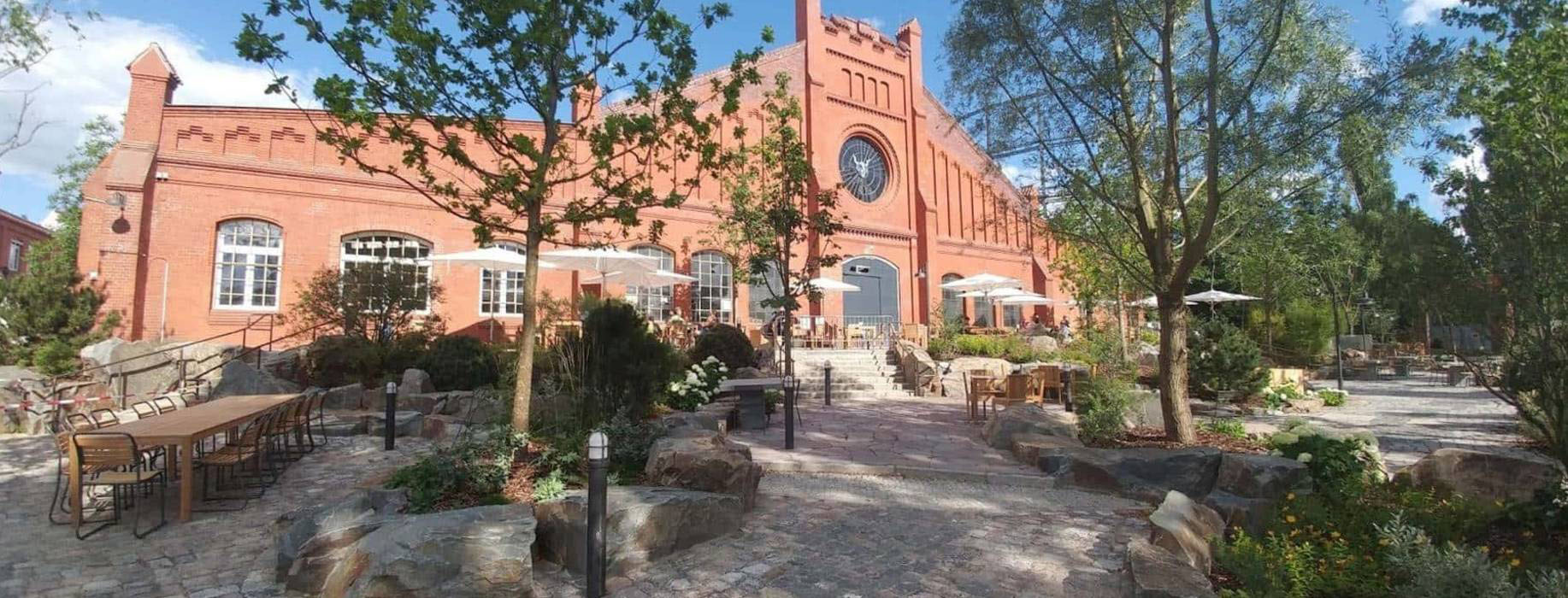
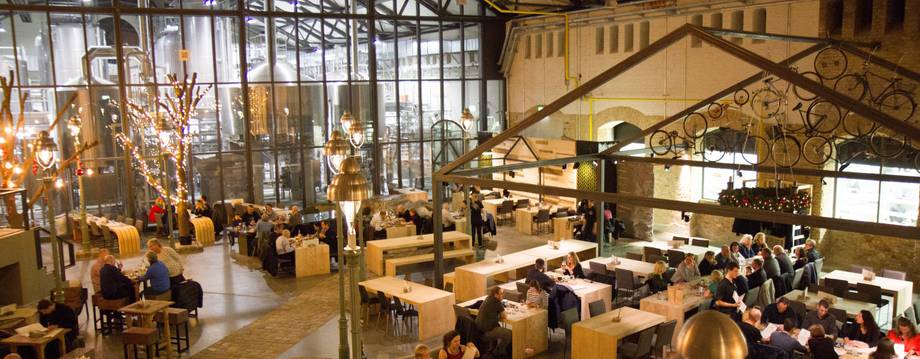
Occupying a cathedral-like redbrick hall at the heart of a former gasworks, it comprises a gleaming, state-of-the-art 100-hectolitre brewhouse, facing onto a 64-line taproom, restaurant and retail store. I realise this all sounds a bit much for our craft beer sensibilities, but it’s just so… well, nice.
The public area is a huge space, taking up easily 70% of the entire building, with lofty ceilings and seating for several hundred guests. Despite being largely empty when we arrive mid-afternoon, the atmosphere is somehow still welcoming, even intimate. Lamp posts, light-strewn trees, pieces of artwork and rough wooden furniture give the feeling of a small town plaza. There are even terraced slopes covered in cushions and beanbags, and by the time evening rolls around these are all occupied by happy visitors, including several families.
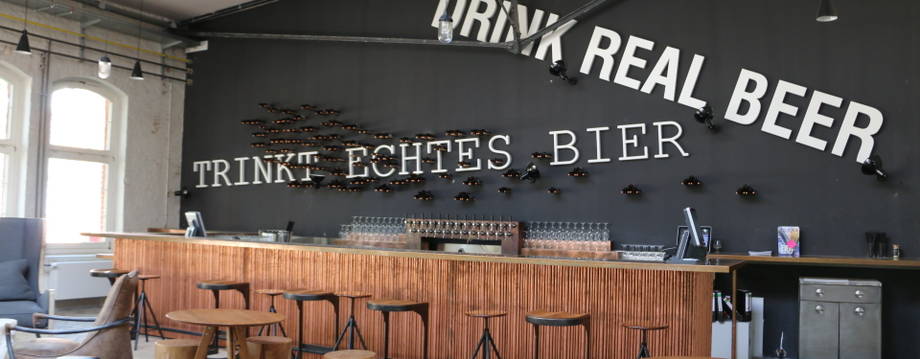
Stone Berlin is said to have a similar feel to the brewery’s first home in Escondido, California. Yet there are also distinct local touches, from the recycled bikes (originally belonging to local residents) and vintage German beer cans to the giant felled tree (liberated from a construction site on the banks of the river Spree).
But the journey from derelict industrial shell to destination brewery hasn’t happened overnight. The process of finding a home in Europe began in 2009, when Stone co-founders Greg Koch and Steve Wagner published a formal ‘request for proposal’ to evaluate potential sites across the continent. The pair considered 130 sites in nine countries, but it wasn’t until July 2014 that plans for their chosen location were revealed.
During this four and a half years, Greg fell in love with Berlin, citing the city’s countercultural undercurrents of arts and music as key reasons for the move, alongside its already thriving craft beer scene.
Few craft breweries have had to deal with the challenge of setting up in a second location, let alone trying to reproduce their beers on a different continent. Add to this the immense pressure of being one of the most revered breweries on the planet, and stewardship of Stone Berlin begins to look a little like a poisoned chalice.
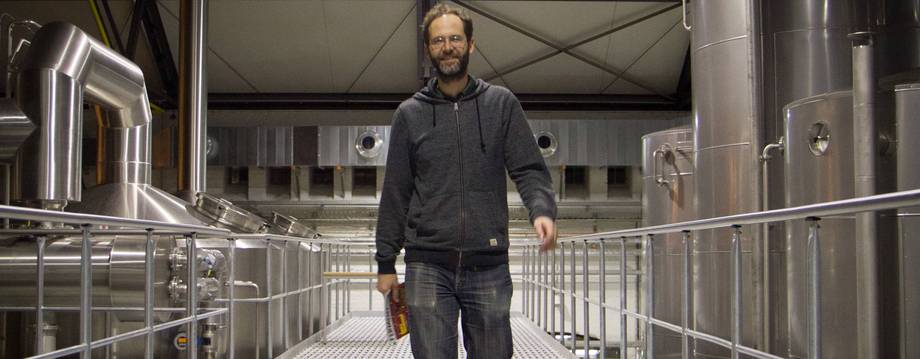
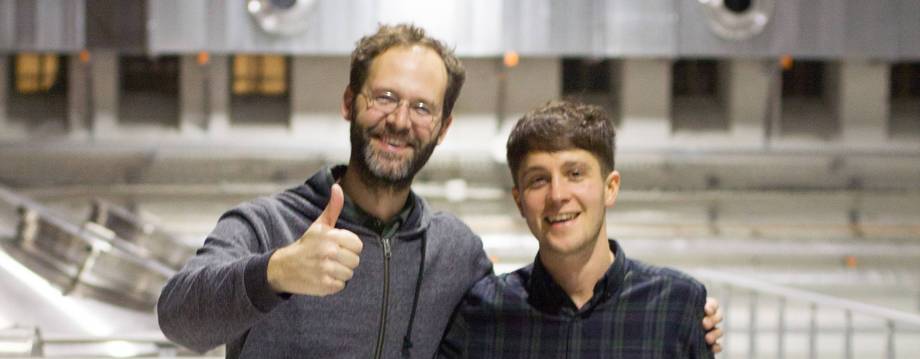
Fortunately, the brewing side of the operation is in the safe hands of an expert team, led by head brewer Thomas Tyrell. Thomas is well known in German beer circles, and brings a wealth of knowledge from his role at Berlin’s VLB brewing institute and as a consultant to breweries large and small. He was hired shortly after the brewery was officially announced, so has seen through the installation and commissioning of the new brewhouse. But what has it been like, dealing with the weight of expectations that come with Stone’s global reputation? “Terrible!” he says with a laugh. “No, it’s been great, because such a high standard has been set; we know how good these beers can be, and when we get it right and produce beers as good as Escondido, that’s a fantastic feeling.”
Thomas spent his first three months with Stone at its home in Escondido, learning the brewery’s processes from quality control to raw materials sourcing. He freely admits it hasn’t all been plain sailing though. The first batch of beers – brewed on a smaller ‘pilot’ kit and sent to 40 pubs across Europe in October 2015 – consisted of three signature styles; Arrogant Bastard, IPA and Xocoveza. “The IPA was good, but it wasn’t quite the same as the US IPA,” he says. “But we tweaked and adjusted, and by the time the big brew kit was ready, we’d perfected it.”
According to Thomas, the single biggest factor in getting every brew absolutely right (the kit is capable of six brews each day) is yeast. For a start, Stone Berlin uses exactly the same cultures as are used in Escondido. In fact, he personally brought the live culture into the country in a suitcase. Beyond that though, he talks with clear passion about the importance of managing and caring for this complex living organism.
“The brewing process has pretty fixed parameters; you know the temperatures you use in mashing, you know your boiling time, the hops that go in and so on. At the moment of pitching though, yeast can bring an unpredictable element if it’s not carefully managed,” says Thomas.
“We check our yeast under a microscope before each brew, to check what shape it’s in. If this seems excessive, consider that each millilitre has around 100 million yeast cells. So a litre has 100 billion. That’s far more than the human population on Earth, and think how hard it would be to control all of us! Each of our beer tanks hold 100 hectolitres, so 10,000 times 100 billion cells. Having those cells strong and happy is essential to making good beer.
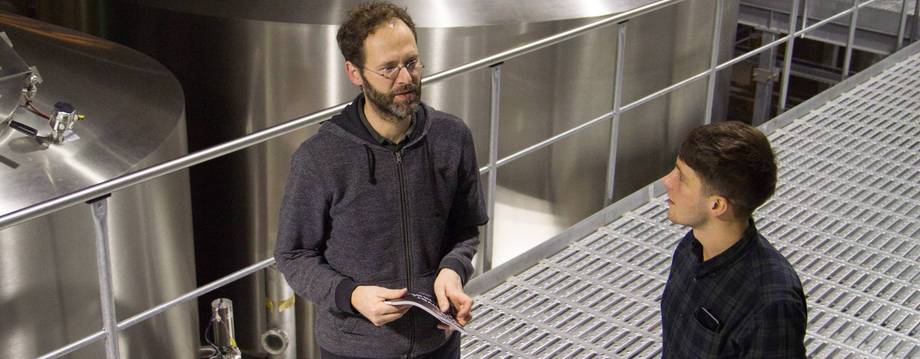
“When you have a very small brewery it’s even harder, because you may not have continuous production, so you don’t have the opportunities to treat the yeast, to revitalise it. This is the biggest challenge for the small brewer - because the amount of work you have to do for a small batch is the same as for a big batch if you want to do it right.” As a German brewer of some pedigree, I’m keen to hear from Thomas how Stone’s spectacular arrival has been received, both by its craft peers and the brewing establishment.
“Germany is obviously a country with a very long beer tradition, and like a lot of craft breweries we’re mainly brewing American styles,” he says. “I think some people are sceptical of what we’re doing here, but I’d say more are happy that something new is happening, while others are just waiting to see how things work out.
“As for the city’s other small breweries, I wouldn’t say we’re leading or influencing anyone. If you look at other big cities around Germany, Berlin was lacking a medium-sized brewery and we’ve filled that gap. We’ve had a lot of media attention because this US brewery setting up shop in an old gasworks is kind of a crazy story, but I see us as part of something much bigger that’s happening in the city just now – something that has a momentum of its own.”
Talking to Thomas, one gets the strong sense that he’s not the kind of person who will be happy slavishly following the styles and recipes passed down from Escondido. Indeed, he’s already brewed a pilot run of a Stone Berliner Weisse – the quintessential Berlin style – which is on tap in the restaurant and is quite delicious. His hope is to keep raising the bar for quality within Stone’s existing styles and even introucing new beers to the regular lineup.
In the meantime though, Stone’s Berlin taproom is doing a roaring trade, bringing in everyone from tourists to business people, and families to beer geeks. It’s not hard to see why: the bar offers not only beers from Stone US and Berlin, but also from some of the best breweries across the city and throughout Germany.
Likewise, quality food has always been a key part of the vision, and executive chef Robert Hilges presides over an ever-changing menu guaranteed to suit every palate. While we’re waiting for our dinner (I chose bratwurst, because why not) I take the opportunity to importune some strangers and find out what they think.
Harry and Barbara, a couple from Austria, are holidaying for a few days in Berlin and, having tried a couple of Stone beers back home, decided to make the journey out for dinner and a drink.
“It’s our first time here yes, and we love the building,” says Harry. “I chose a dry-hopped Stone IPA and we also have a vanilla porter here; they’re both great – very fresh. The bar has a really good selection and there are lots of beers I’ve not seen anywhere else. I do enjoy traditional styles like Bavarian wheat beer and Austrian lagers, but we’re also fans of the American and British styles too. I think Stone will do well here.”
Also from Austria, Christian is part of a tour group from another brewery (as luck would have it) all of whom are fizzing with excitement at the beers on offer and the shiny new brewkit on the other side of the glass wall.
“It’s amazing, and makes such a good impression,” says Christian. “It’s very US-style, in that you arrive here and are immediately given this very immersive experience. I think it’s really a landmark for US brewing in Europe, not just Berlin, simply because nobody here would do something like this.
“In Austria and Germany, we already have a craft beer culture – our small breweries have been pursuing craft for hundreds of years, with their own recipes and styles. Those traditional breweries are still very important, but there’s also now a lot of demand for much more hop-forward styles and dark British styles. So to come somewhere like this, where all those traditions are brought together in such great surroundings… it’s very exciting for us as brewers.”
Assuming Stone does indeed make a success of its European base though, does its arrival also set a worrying precedent for the continent’s smaller craft breweries? It’s certainly brewing to a scale and standard that will give it enormous competitive clout. But it should also give smaller players something to aspire to; a case study in what is possible when you accept that integrity and ambition can go hand-in-hand. If this is the future of craft brewing, then Stone gives us all good reason to be excited.
Share this article
You’ve reached your limit of 5 free articles this month.
Unlock unlimited access and more

Join Beer52 and get your first month half price
-
Get your first box for £13.50 (RRP £27).
-
8 beers & 2 snacks delivered monthly.
-
Printed Ferment magazine included.
-
Unlimited access to all online content.